







RAINBOW CRAFT FOR YOUNG CHILDREN

April 6, 2020

Our family just loves rainbows, year round. But I like when rainbows get a little extra highlight around easter and in spring too. It is perfect for spring rain storms and how easter includes remembering God’s promises. This craft is a good one for a range of children’s ages, including very young. I found it fun and soothing even as an adult – concentric circles, orderly proceeding colors. The satisfaction of the final cut at the end to make the two rainbows! We did the standard rainbow shades but other versions – like maybe a pastels one – would be so pretty!

Also it’s a great introductory craft for young children getting to start practicing with scissors.

MATERIALS

  1. Colorful paper
  2. Scissors
  3. Glue
  4. Pencil
  5. Seven bowls of different sizes

INSTRUCTIONS

  1. Trace around largest bowl on first color paper (perhaps red). Cut out with scissors.
  2. Repeat with remaining colors. We did seven for red, orange, yellow, green, blue, indigo, and violet.
  3. Glue papers together, centered on each other.
  4. Cut circles in half to produce two rainbows!

These are decorating our house for spring, but I just love a good little rainbow. So I may keep one tucked in a children’s bedroom or the playroom year round.

You may also like this painted binoculars craft, how to actually do some art with children, and favorite kid art supplies that make it easy.

Our family just loves rainbows, year round. But I like when rainbows get a little extra highlight around easter and in spring too. It is perfect for spring rain storms and how easter includes remembering God’s promises. This craft is a good one for a range of children’s ages, including very young.

READ MORE

DIY Hanging Wallpaper (The Permanent Kind!)

December 2, 2019

One of the most helpful exercises for people who are trying to design their own home is to of course gather inspiration (pinterest and instagram are the faves for this) but ALSO study the photos you are drawn to and figure out why exactly you were drawn to it. So I have a million pins on my boards, but when I started reviewing them and observing common themes is when I have began refining my taste and identifying enduring design favorites.

I can’t turn down a space with a great WALLPAPER. Once I learned this I noticed myself immediately pin-ing an image, and then when I studied the photo to see why I reacted so strongly to it, I would sometimes see that there really wasn’t anything I specifically liked in the photo except a great patterned wallpaper. And then I am drawn to the whole thing!

Sounds like a pretty powerful design element and quite worth doing! I just love wallpapers in rooms. I wanted to add some wallpaper to our master bedroom!

I was looking for a sculptural pattern in blue green tones. This mimosa print immediately stood out to me and tested samples of “tranquil crop,” “wattle green,” and “red tango.” I was so torn because they were all really good blue based options. After much ado, I made my choice and Milton & King sent me three rolls of the “wattle green.”

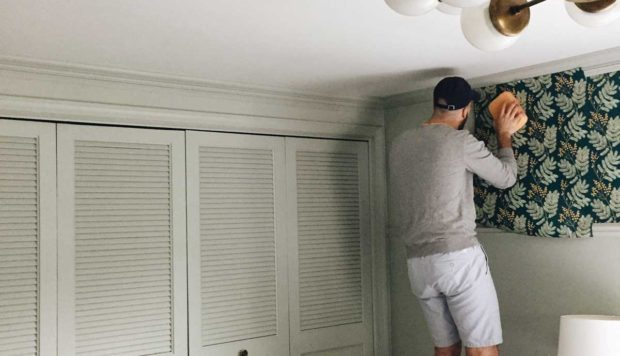
We were deciding between doing peel-n-stick or permanent paper. David said he preferred learning to install the permanent kind so we went with it! It was not hard! (At least with this kind!) Here’s exactly how to do it.

MATERIALS

  1. wallpaper adhesive ($13)
  2. foam roller ($9)
  3. foam brush ($2)
  4. snap off utility knife ($12)
  5. knife blades ($8)
  6. drywall knife ($12)
  7. sponge ($3)
  8. seam roller ($5)

PROCESS

  1. Prep the walls by scraping with a drywall knife and patching any holes. After that clean with a damp soapy rag. 
  2. Choose your starting place. It’s recommended to start at a prominent light source (like a window) and work away from that point toward a corner with low visibility (like near an entry door). The seam where you finish papering should be the only place where the wallpaper’s pattern does not line up. 
  3. Measure your wallpaper’s width and subtract 1/2”. Make a pencil mark that distance away from your starting point and create a plumb line using a level or plumb bob. When you install your first piece of wallpaper, you’ll line one edge up with the plumb line and overlap the extra 1/2” on the other side around the corner where you started. Since not all walls or window frames are square, this allows you to start your papering using the plumb line you drew with the pencil instead of relying on the starting corner for straightness. 
  4. Using the width of the wallpaper, measure from the plumb line and make another pencil mark. Continue doing this until you’ve marked the entire room. These marks show you where your seams will be. If any seams will be too close to an obstacle, you can adjust your starting point to change any unwanted seam locations. 
  5. When you’re ready to attach your starting piece, cut a length from the wallpaper roll that’s 4” longer than the space you’ll be covering on the wall. This allows 2” of paper on the top and bottom that can be trimmed. 
  6. Spread an even layer of wallpaper adhesive on the section of the wall you’ll be papering. Use a foam brush to cut in around obstacles and cover the rest with a roller. Be sure to put adhesive about 1” past the the point on the wall where the edge of the paper will be so the seams will stick well to the wall. 
  7. Line up the edge of the paper with the plumb line and gently press the paper on the wall. As you do this, smooth out bubbles with the sponge, working from top to bottom and middle to outside. If something goes wrong and you have to take the paper off the wall, that’s ok – you can spread some more adhesive on the wall if needed and reapply the paper. 
  8. At locations where the paper comes in contact with a corner or the top or bottom of the wall, you’ll need to cut the excess with a utility knife. While being careful not to rip the paper, hold a drywall knife into the corner where you’ll be cutting to create a straight edge. Change your knife blade often so a dull blade doesn’t rip the wallpaper. I changed mine almost every time I made a cut. When the wallpaper needs to go around a corner like on a door frame, you can make a relief cut with scissors at the corner to allow the paper to fold in the right direction to move into position.
  9. After you’ve completed smoothing your first piece on the wall, you can cut another piece, apply adhesive to the wall, and line up the new piece with the edge of the paper that’s already on the wall. Smooth the new piece using the sponge and trim off excess paper. 
  10. Use the seam roller to set the edges of both pieces in place by rolling firmly over the seam. 
  11. Repeat the process of cutting paper, applying adhesive, and smoothing the paper onto the wall until you’ve come to the corner where the pattern will be misaligned. Then return to your starting point and use the exposed edge of the first piece of wallpaper to start going the opposite direction in the room until you reach the final corner. Be sure to always use the full width of the wallpaper sheets until the very last corner so your pattern will only misalign in one place. 

After this project – my verdict: I LOVE WALLPAPER EVEN MORE. I can’t wait to install some more. The experience putting it up was easier than we expected and its effect on the overall room is so strong. I love color but I like, love love pattern and the way mixing patterns feels in a room.

Closing comment – do wallpaper!

One of the most helpful exercises for people who are trying to design their own home is to of course gather inspiration (pinterest and instagram are the faves for this) but ALSO study the photos you are drawn to and figure out why exactly you were drawn to it. 

READ MORE

GREEN VEGETABLE SOUP WITH ROASTED CHICKPEAS

July 23, 2019

I have churned through many chunky, broth based soups and stews over the years, but lately I am getting into pureed soups. COULD BE related to my recent acquisition of an immersion blender, which makes it easy. My policy though, is that pureed soups are significantly better if you have a little topping of some kind with a different texture or crunch. I think it’s really kind of a requirement, actually. This soup has so many vegetables you wouldn’t believe it (love), but the chickpeas roasted in Dijon and honey mustard flavors make it something way, way better.

David and I did not stop snacking on those crispy little chickpeas.

And, one of the best parts is you can have this chilled in the summer OR warm and cozy in the winter.

Green Vegetable Soup with Roasted Chickpeas
Serves six

15 ounces chickpeas
1/4 cup BRIANNAS Dijon Honey Mustard Dressing, divided
2 cups cauliflower florets
1 yellow squash, chopped
1 zucchini, chopped
1 bunch kale, de-stemmed and chopped
8 cloves garlic
1 tablespoon olive oil
1 teaspoon basil
1/2 teaspoon thyme
1/2 teaspoon salt
1/2 teaspoon pepper
15 ounces coconut milk
1 tablespoon apple cider vinegar
2 cups vegetable broth
2 cups peas
Fresh parsley
1/2 red onion, sliced thinly

Preheat oven to 400 degrees. Toss chickpeas in 1 tablespoon BRIANNAS Dijon Honey Mustard and spread into an even layer on a lined baking sheet. Roast for 25 minutes.

Bring cauliflower, yellow squash, zucchini, kale, garlic, olive oil, basil, salt, thyme, pepper, coconut milk, apple cider vinegar, 2 tablespoons Dijon honey mustard, and vegetable broth to boil in a large pot. Once boiling, reduce heat to low and simmer for 20 minutes.

Stir in peas. Transfer soup to a blender or using an immersion blender, puree until smooth.

Chill soup in refrigerator or serve warm. Top with roasted chickpeas, fresh parsley, red onion, and an additional 1 tablespoon drizzle of Dijon honey mustard.


GREEN VEGETABLE SOUP WITH ROASTED CHICKPEAS
 
Author:
Ingredients
  • 15 ounces chickpeas
  • ¼ cup BRIANNAS Dijon Honey Mustard Dressing, divided
  • 2 cups cauliflower florets
  • 1 yellow squash, chopped
  • 1 zucchini, chopped
  • 1 bunch kale, de-stemmed and chopped
  • 8 cloves garlic
  • 1 tablespoon olive oil
  • 1 teaspoon basil
  • ½ teaspoon thyme
  • ½ teaspoon salt
  • ½ teaspoon pepper
  • 15 ounces coconut milk
  • 1 tablespoon apple cider vinegar
  • 2 cups vegetable broth
  • 2 cups peas
  • Fresh parsley
  • ½ red onion, sliced thinly
Instructions
  1. Preheat oven to 400 degrees. Toss chickpeas in 1 tablespoon BRIANNAS Dijon Honey Mustard and spread into an even layer on a lined baking sheet. Roast for 25 minutes.
  2. Bring cauliflower, yellow squash, zucchini, kale, garlic, olive oil, basil, salt, thyme, pepper, coconut milk, apple cider vinegar, 2 tablespoons Dijon honey mustard, and vegetable broth to boil in a large pot. Once boiling, reduce heat to low and simmer for 20 minutes.
  3. Stir in peas. Transfer soup to a blender or using an immersion blender, puree until smooth.
  4. Chill soup in refrigerator or serve warm. Top with roasted chickpeas, fresh parsley, red onion, and an additional 1 tablespoon drizzle of Dijon honey mustard.


I have churned through many chunky, broth based soups and stews over the years, but lately I am getting into pureed soups. COULD BE related to my recent acquisition of an immersion blender, which makes it easy. My policy though,

READ MORE

Copyright © Rachel Schultz 2026

PRIVACY POLICY